
What you need to know about
Peacock Gap Lagoon
Interest in helping take care of the lagoon?
The lagoon is a treasured feature of our neighborhood—but like any natural body of water, it needs care to stay healthy. This page provides an overview of lagoon maintenance efforts, clarifies who is responsible for what, offers ways you can help, and explains what's going on with the current algae bloom.
Lagoon Maintenance Timeline
Thanks to the dedication of one generous neighbor (who covers all costs out of pocket), the lagoon has seen significant improvements in recent years. Here’s a brief timeline of efforts.
What You Can Do to Help the Lagoon?
While one neighbor has done a tremendous amount to improve lagoon health, it’s a shared resource—and shared responsibility. If the homes on the lagoon took these three steps, it would really help the health of the lagoon.
-
Start Your Own Muckbiotics Program
Muckbiotics are a beneficial bacteria that break down muck and reduce the nutrients algae needs to grow. They treat the entire water body by starting at the bottom by digesting organic matter and are a non-toxic, non-hazardous, and sustainable solution for water quality management.
- Recommended Use: 15 lbs per month
- Cost: ~$1,200 a year
- How to Apply: Scoop around your dock (10–15 ft out)
- Where to Get It: Buy from LakeTech
-
Install a Water Circulator
Circulation helps prevent algae and supports oxygenation.
- Product: AquatiClear by Kasco
- Cost: ~$1,899 including unit, dock mount and installation
- Where to Get It: Buy from LakeTech
- Product:Kasco VFX Series Fountain
- Cost: ~$1,662.00 does not inlcude instalation
- Where to Get It: Buy from LakeTech
-
Remove Debris From Your Dock Area
Dead algae or widgeon can be removed with a rake or by a gardener. Letting it sit increases nutrient buildup and can trigger more algae growth.
Please Note: The HOA is not affiliated with LakeTech, and assumes no no responsibility for the Muckbiotics and water circulators they provide. We share these resources for informational purposes only.
Chemical solutions are not permitted in the lagoon. All actions must be environmentally friendly because the lagoon runs into the bay.
What’s Happened With the July 2025 Algae Bloom?
This season’s algae bloom has understandably caused concern.
Here’s what’s happening:
- Water clarity was at an all-time high this spring, thanks to years of maintenance.
- Those clear conditions triggered a major widgeon grass bloom — the largest seen in 17 years, nearly 50% of the lagoon.
- Widgeon is a healthy sign in moderation, but in large amounts, it dies off and floats, creating a perfect habitat for algae.
- Add warm weather, shallow water, and nutrient-rich sediment—algae’s three favorite things — and the result is the current large scale algae bloom.
What is being done to maintain the health of the lagoon?
- We still have the nanobubbler running, are swapping out the water and distributing Muckbiotics. However, algae blooms are "normal" and we are not permitted to put any chemicals into the lagoon. All solutions must be environmentally friendly because the lagoon runs into the bay.
Will this happen again next year?
- Probably not, but mother nature is in charge. Widgeon rarely blooms this heavily in consecutive years.
- If it does return, we’re hopeful next year will be much milder.
2025 Algae Bloom
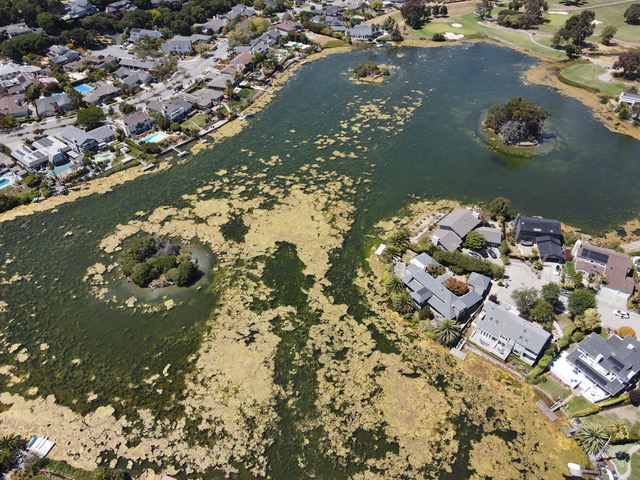
Algae Bloom July & August 2025